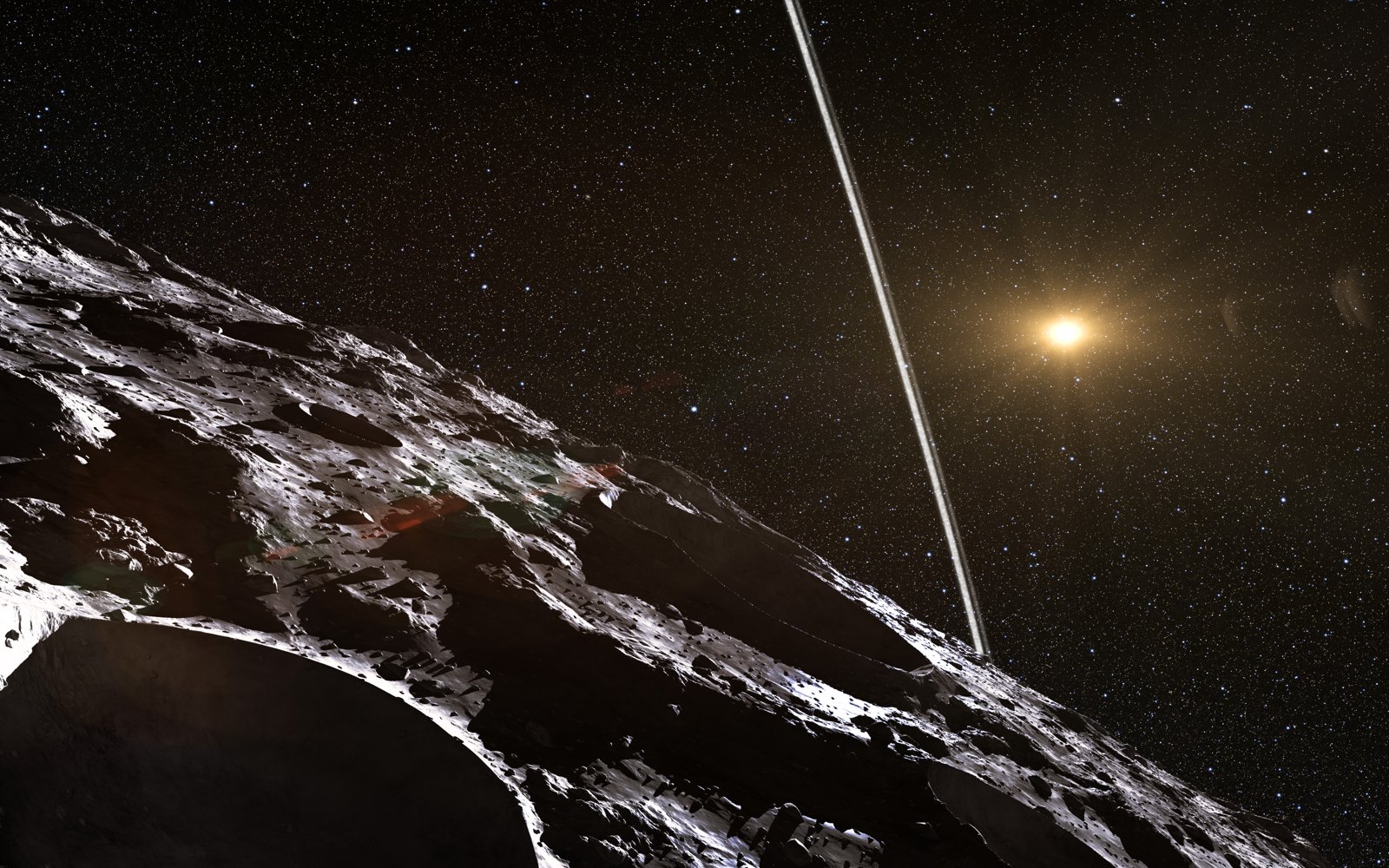
In March 2014 a supernova survey photographed the same patch of sky over and over with the 4-meter Blanco telescope in Chile. One dot in those images barely moved: a fifth of the speed of the asteroids around it. I tracked it across five nights and worked out how far away it has to be. The answer is somewhere between 15 and 27 times Earth’s distance from the Sun, about twice as far out as Saturn. Nobody had reported it. It’s now with the Minor Planet Center as 1F916AR.
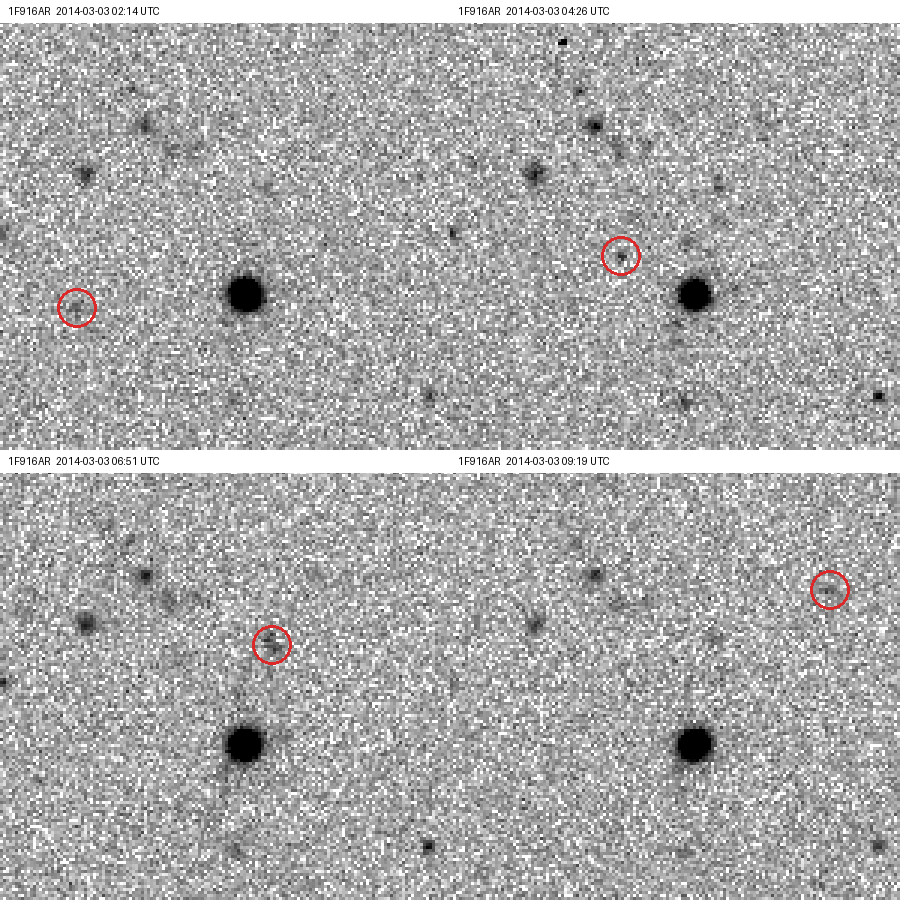
Most asteroids in these images move about 0.2° a day. 1F916AR moves 0.043°. That slowness is the whole story: the farther away something is, the slower it seems to crawl as Earth swings past it. I found it on 11 images over five nights (1–5 March 2014), and one orbit fits all 11 positions to 0.16 arcseconds on average.
Five nights isn’t enough to pin an orbit down, so I didn’t pick one. I tested thousands: every combination of distance and speed that could reproduce what the telescope saw. Every orbit that fits puts it 15 to 27 AU from the Sun (1 AU is Earth’s distance). Saturn is at 9.5 AU, Uranus at 19.2, Neptune at 30.1. Every one of those orbits is also tilted at least 14° to the plane the planets travel in.
That range is where the Centaurs live: icy bodies left over from the planets’ birth, drifting between Jupiter and Neptune on orbits the giant planets keep reshaping. Some eventually fall inward and become comets. Whether 1F916AR is formally a Centaur depends on an orbit five nights can’t settle, so for now it’s a possible one.
It’s faint, around magnitude 23, but it’s faint from very far away. At its most likely distance, about 20 AU, that brightness means something roughly 40–60 km across, if it’s as dark as other Centaurs. That’s my estimate, not a measurement: closer in it would be smaller, farther out bigger. For comparison, most of the 29 objects I sent in last week are a few kilometers or less.
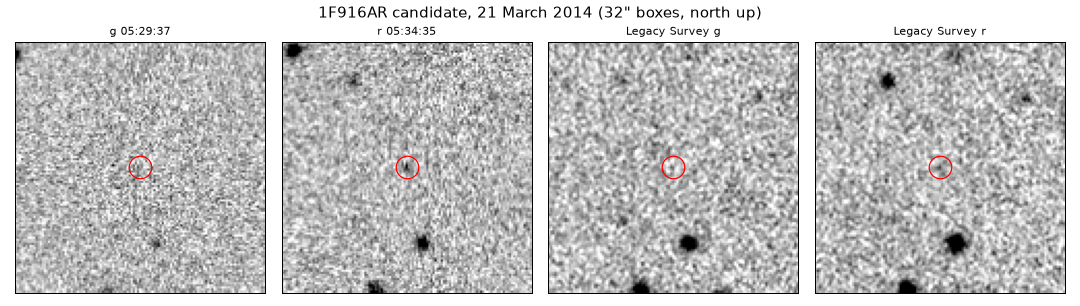
Another DECam program photographed the spot where 1F916AR should have been on the night of 21 March 2014. In one of its images there’s a faint dot 1 arcsecond from the predicted track, and nothing in the deep sky survey that maps the stars and galaxies there. NOIRLab’s own source catalog logged it too, as a one-time detection. But it’s right at the edge of what that image can see, and the second image from that night put the spot in a gap between camera chips. One faint dot isn’t enough to report, so I didn’t send it.
While searching for 1F916AR in 2013 images, I found something else. On 16 March 2013, in three deep exposures from a program run by Scott Sheppard, a different dot moves 3.3 arcseconds an hour in a clean straight line. That’s even slower, and the same test gives 35 to 52 AU: past Neptune, in the Kuiper belt. The service I used to check for known objects showed nothing within 3.6 arcminutes of it, and the Center’s file of sightings nobody has linked to an object has nothing within 10 arcminutes that week.
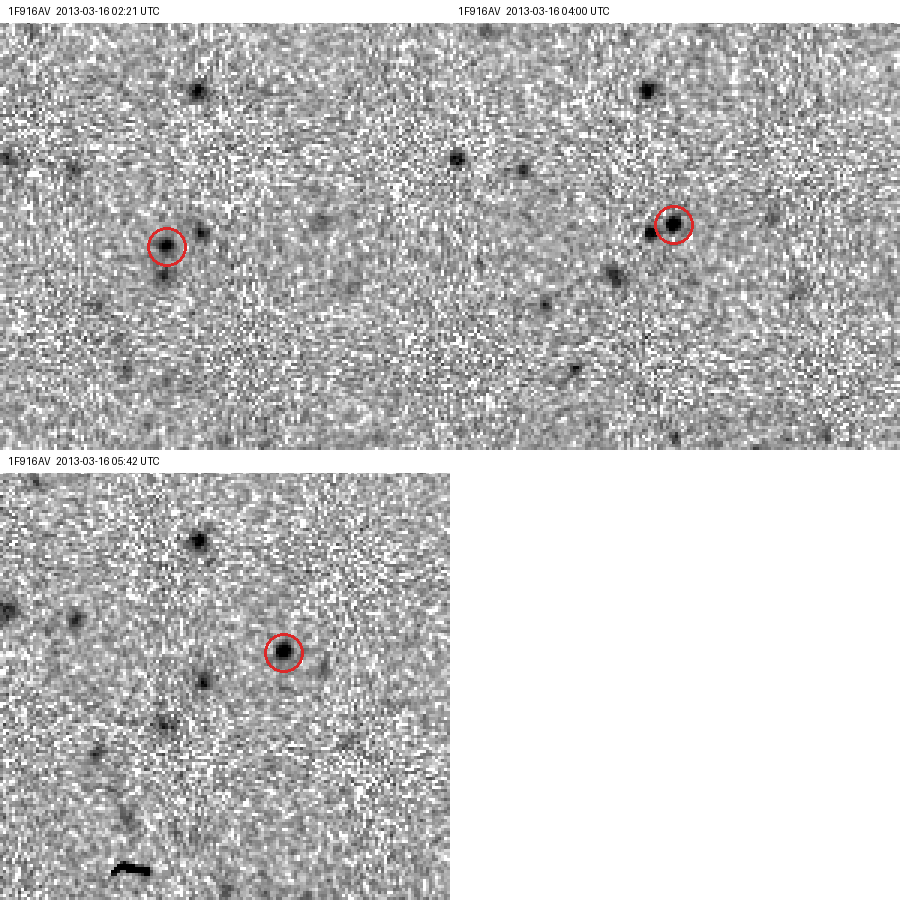
I sent that night to the Center, tagged 1F916AV.
Update, 13 October 2026: it isn’t new. The Center flagged all three of my measurements as near-duplicates, which means it already holds sightings from that night at the same spot. Its own checker puts the known Kuiper belt object 2016 FY58 exactly where my dot is, at the same brightness and the same speed. 2016 FY58 circles the Sun about 42 AU out, inside the 35 to 52 AU my test gave, so the distance was right and the newness was wrong. The service I’d checked against didn’t show it. Every candidate now goes through the Center’s own checker too.
1F916AR. The Minor Planet Center’s reply, word for word: [1F916 batch 3: archival DECam W84 2014 Feb 28-Mar 5, 29 objects 1F916S-1F916AU]. Submission ID is 2026-10-09T08:26:28.475_0000CFgZ. Live status: minorplanetcenter.net.
1F916AV. The Center’s reply, word for word: [1F916AV: archival DECam W84 2013 Mar 16, slow distant mover 1F916AV]. Submission ID is 2026-10-12T13:37:18.263_0000CGAk. Live status: minorplanetcenter.net. Result: flagged as a near-duplicate; it is the known object 2016 FY58.
From 11 observations 2014 Mar. 1-5; mean residual 0".16
Nominal fit: a 14.66 au, e 0.46, i 40.3° (all poorly constrained)
Distance from Sun on 2014 Mar 3: 20.7 au; H 10.06
Ranging over every orbit that fits: 15–27 au from the Sun, tilt 14° or more
| UTC (mid-exposure) | RA° | Dec° | G mag | S/N | Gaia stars |
|---|---|---|---|---|---|
| 2013-03-16 02:21:19 | 168.9406573 | −2.2613485 | 23.43 | 13 | 48 |
| 2013-03-16 04:00:50 | 168.9392426 | −2.2608073 | 22.94 | 23 | 50 |
| 2013-03-16 05:42:01 | 168.9377718 | −2.2602464 | 23.00 | 23 | 43 |
The Center checks 1F916AR against everything it holds, then either gives it a designation or matches it to something already known. Old archival observations sit low in its queue, so this can take weeks. Either way, this page will say what came back.