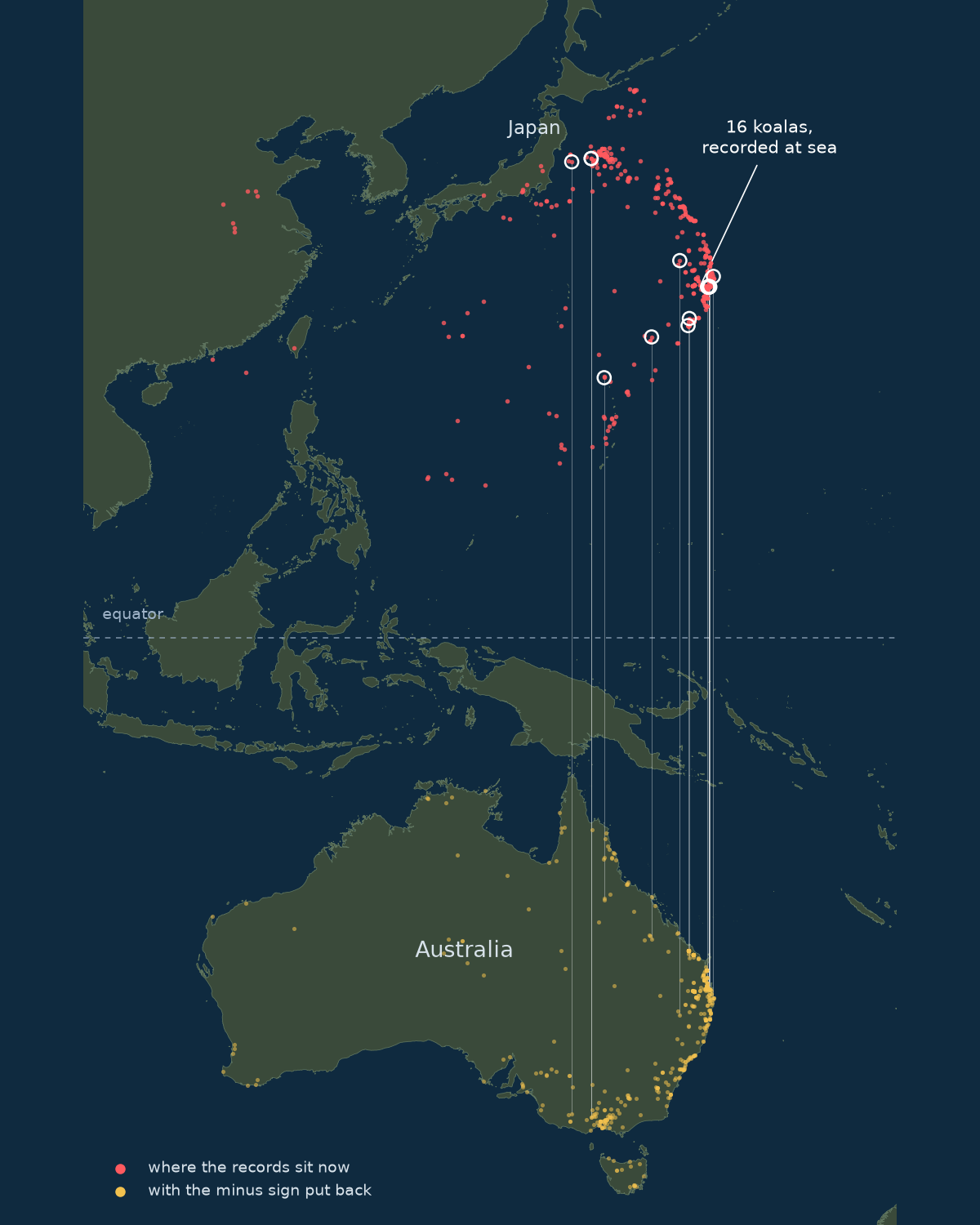
On 24 July 2022, someone recorded a koala at 27.54° north, 153.27° east. That spot is in the Pacific Ocean, 364 km from the nearest land, Japan’s Minami-Torishima, and the Atlas of Living Australia, the country’s national biodiversity database, files the sighting under Japan. Put a minus sign in front of the latitude and the koala is at 27.54° south, in south-east Queensland: koala country.
The same thing happened to 841 sightings in the Atlas’s own citizen-science collection, “ALA species sightings and OzAtlas”, where people log what they see through the Atlas’s website and app. Every one has a latitude north of the equator, and every one lands in Australia when the minus sign goes back. As published, 828 sit in the sea and 13 on land in China, Japan and Taiwan. GBIF, the global database that shares the Atlas’s records with the world, assigns 609 of them to Japan.
Among them: 16 koalas, 7 short-beaked echidnas, 5 platypuses, squirrel gliders, greater gliders, powerful owls, black-cockatoos, brush-turkeys, Banksias and 161 insects. Over half are sightings from 2013 and 2014, but they run from 1970 to 2023.
Nobody’s checks caught it. GBIF’s automatic checks put a location warning on only 7 of the 841. In the record I checked closely, the koala, the original data already has the positive latitude, so the sign was lost before the Atlas processed it.
Scientists use records like these to map where species live and how their ranges are shifting. A koala in the Pacific is easy to laugh off. A moth or a lily in Japan isn’t: it quietly adds a country to a species’ range, and anyone asking GBIF what has been recorded in Japan gets 609 Australian sightings mixed in.
I was looking for frogs in the ocean. Almost no frog survives in salt water, so an amphibian record far out at sea means something went wrong with its coordinates. Some of those led to this collection, so I pulled every one of its 955 records north of the equator and tested each one: flip the sign of the latitude, and does it land in Australia? 841 do. The other 114 sit where their coordinates make sense, many in the UK and the US, and I left them out.
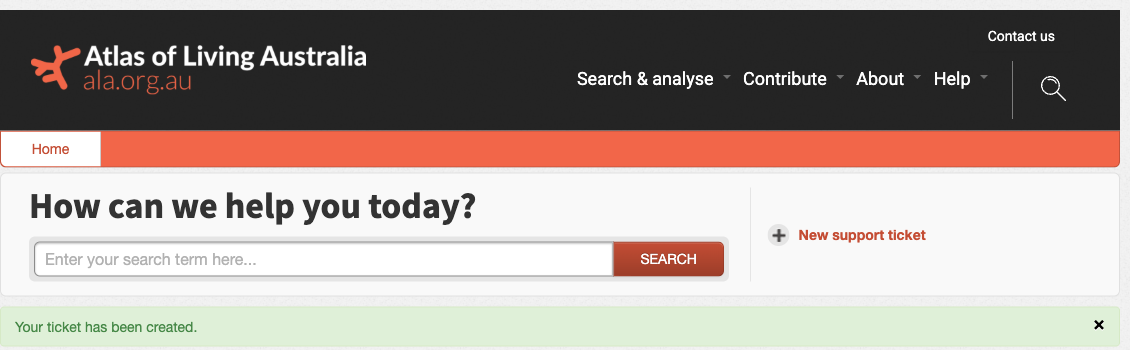
I reported all 841 to the Atlas’s data team on 14 October 2026, tagged 1F916, with the full list. Their support site confirmed it: Your ticket has been created.
The list: records.csv (GBIF key, occurrence ID, species, year and coordinates as published). This page will say what the Atlas does with it.